
Hi, I am loading the site

Lawing Tech

​

Skip to content
Lawing Tech

Technology watch

News

What matters in cybersecurity, cloud and telecoms, CCTV, software, artificial intelligence and public sector IT, with the essential tech news from Benin and the world. Every article is built on public sources, cited at its end.

Loading the news

Back to news

Google Research Validates an AI Model to Assess Gestational Age Without Ultrasound Experts

Google Research and its partners have demonstrated that an artificial intelligence model can assess gestational age through simplified ultrasound imaging, without requiring a specialized operator. Tested in Chicago and Nairobi, the system shows accuracy equivalent to that of experts, opening perspectives for areas where access to ultrasounds is limited.

by Lawing Tech Newsroom (3 min read)
Google Research Validates an AI Model to Assess Gestational Age Without Ultrasound Experts
Video: Ask a Scientist | How are researchers using AI to improve maternal health research? (Google, YouTube)

A Generalizable and Accurate AI Model, Tested in Diverse Contexts

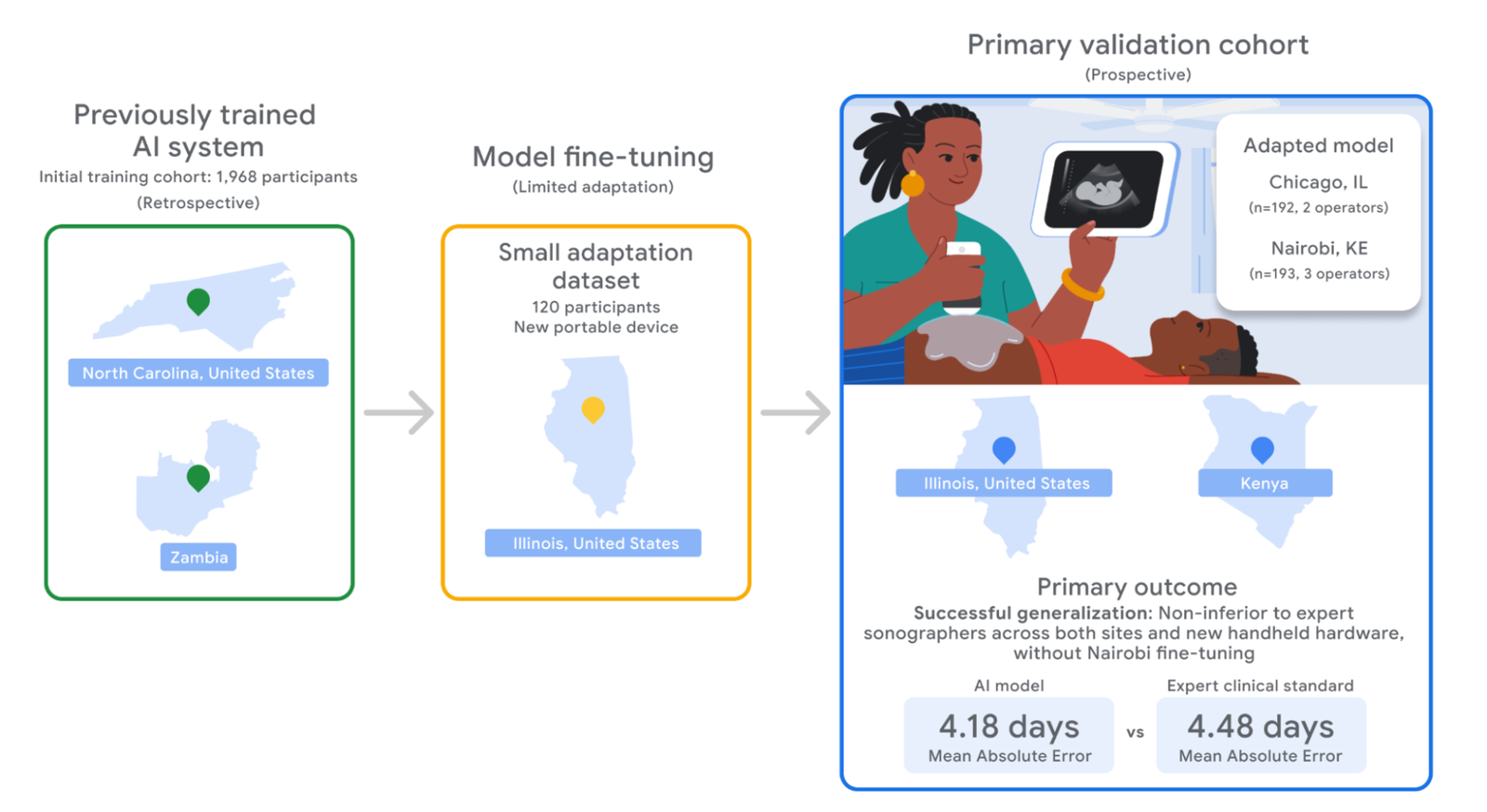
A study published in JAMA Network Open evaluates an artificial intelligence model developed by Google Research and Google for Health, designed to estimate gestational age from ultrasounds performed by non-specialized operators. The system, based on a technique called « blind sweep ultrasonography » (blind-sweep ultrasound), was trained on data from the United States (North Carolina) and Zambia, then refined with participants from Chicago (United States) and prospectively tested in the same city as well as in Nairobi (Kenya). No data from Nairobi was used for model adjustment, confirming its robustness in different clinical environments.

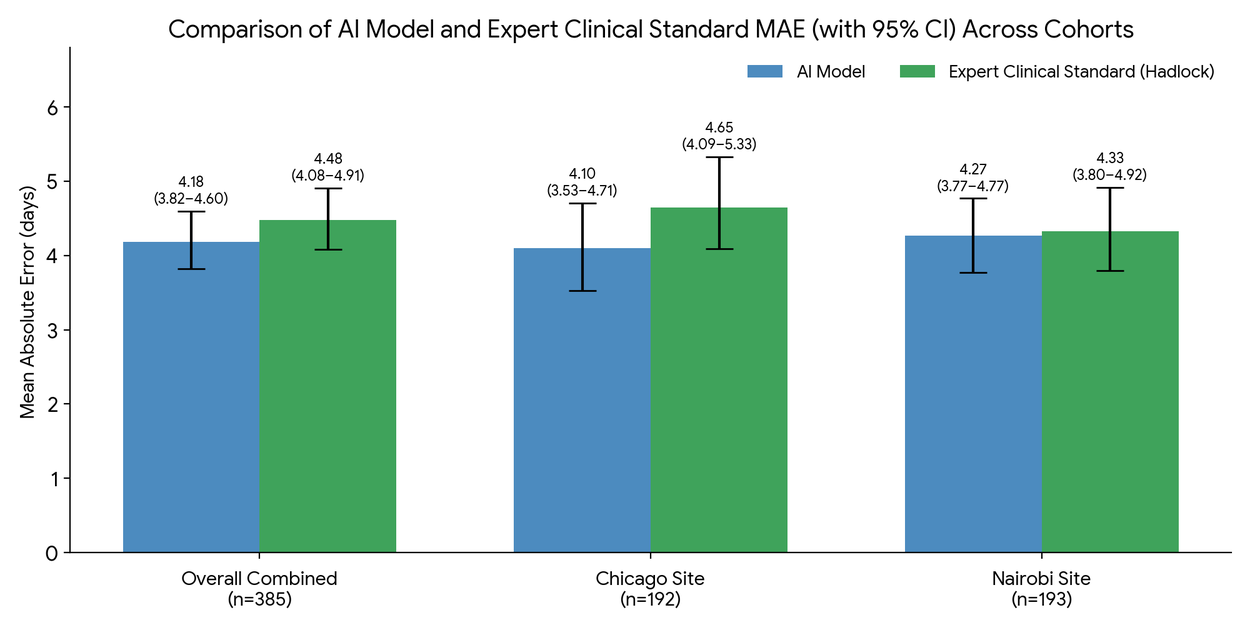
The results show that the system’s mean absolute error (4.18 days) is comparable to that of expert sonographers (4.48 days), according to data reported by Google Research. This performance was validated even in complex cases, such as multiple pregnancies, and the model easily adapts to new equipment, like the Clarius C3 probe, with minimal adjustments.

Gestational age serves as the reference for all screenings, treatments, and decisions regarding delivery dates, a precision that could transform prenatal care in under-equipped areas.

Empowering frontline maternal care with AI-assisted ultrasound
Image: Empowering frontline maternal care with AI-assisted ultrasound (Google Research, official image)

A Solution to Address Limited Access to Prenatal Ultrasounds

Two-thirds of the global population lack access to prenatal ultrasounds due to logistical, financial, or human constraints, notes Google Research. The proposed AI model aims to reduce this inequality by enabling non-trained operators to obtain reliable gestational age estimates, a crucial parameter for medical monitoring. Nichole Young-Lin, an obstetrician cited in the study, emphasizes that « gestational age serves as the reference for all screenings, treatments, and decisions regarding delivery dates. » Improved accuracy in these assessments could therefore enhance patient care, particularly in resource-limited areas.
Flowchart outlining the AI model's training, fine-tuning, and validation process across multiple global clinical sites.
Image: Flowchart outlining the AI model’s training, fine-tuning, and validation process across multiple global clinical sites. (Google Research, official image)

What This Means Here: Potential Applications for Benin and West Africa

In Benin, as in much of West Africa, health systems face similar challenges: a shortage of specialized medical staff, inequalities in access to advanced medical equipment, and regional disparities in the quality of prenatal care. A model like the one developed by Google Research could be adapted to reduce these gaps by enabling clinics and hospitals, even those in rural areas, to use simplified ultrasounds with AI assistance. This could also ease the burden on healthcare professionals by automating part of routine diagnostics, while improving the reliability of data collected for public health programs.

However, its deployment would depend on several factors: acceptance by local health authorities, the availability of compatible equipment, and the training of end users. Collaboration with actors like the World Health Organization (WHO), which supported the study, could facilitate its integration into regional health policies.

Technology designed to evolve with local constraints

One of the key strengths of this model lies in its ability to adapt to different types of ultrasound equipment, as demonstrated by tests conducted with probes from various brands (Sonosite, GE, Butterfly Networks, Clarius C3). This flexibility could be an advantage for countries where medical equipment is often mismatched or outdated. Additionally, the 'blind sweep' method does not require advanced technical skills to perform examinations, which could accelerate its adoption in contexts where human resources are scarce.

Google Research also notes that the model was designed to be deployed in resource-limited environments, an essential criterion for its adoption in Sub-Saharan Africa. The next steps could include additional tests in other regions of the continent, in collaboration with local partners, to refine its effectiveness and operational utility.

Sources

  1. Empowering frontline maternal care with AI-assisted ultrasoundGoogle Research, 21 October 2026

Prepared by Lawing Tech's technology watch from the sources cited. Our editorial charter

Latest articles

  1. PHP releases emergency patches for two critical vulnerabilities exploited before official disclosure
  2. Hanwha Vision Launches the SPS-A8016: An All-in-One Camera to Secure Indoor Spaces with AI and Audio
  3. Digital Africa invests in ChipChip to revolutionize digital agriculture in Ethiopia
  4. PHP releases emergency patches for two undisclosed critical RCE vulnerabilities on October 21, 2026
  5. i14 optimizes its Laplace 3B model on AWS Trainium2 with PyTorch for ultra-efficient linear attention
  6. Amazon ECS Gateway: A Turnkey Solution to Simplify ECS Container Ingress Networking
  7. Gallagher Security Receives NPSA Approval for Its High Sec T30 Biometric Keyboard: A Benchmark in Critical Security
  8. Stanbic Bank Ghana and RD Technologies Test Stablecoins for B2B Cross-Border Payments to Asia
  9. CERT-FR warns of actively exploited critical vulnerabilities: from Windows to Danfoss, systems under scrutiny
  10. TwelveLabs Pegasus 1.5 on Amazon Bedrock: Video Segmentation and Real-Time Processing Now Accessible
  11. The ARCEP of Benin Publishes the Updated List of Approved Radio Equipment and Terminals as of September 30, 2026
  12. ECOWAS and AES: a framework cooperation agreement in preparation after the Dakar ministerial meeting
  13. Drone attack on the chemical tanker Wine Trader: nine Beninese sailors among the missing in the Black Sea
  14. SiteGuard Server Edition: A Critical Flaw (CVE-2026-106931) Exploited to Gain Server Control
  15. The Regulatory Council Rejects Allegations of Irregularities in the GBESSOKE Programme: What Consequences for Public and Private Actors?
  16. Chain Attack via ConnectWise Cloud Backup: How Hackers Exploited Microsoft 365
  17. Databricks Generalizes Multi-Statement Transactions on Its Lakehouse: A Revolution for Data Consistency
  18. The UK’s CMA considers granting Microsoft strategic status in professional software
  19. GSMA Reveals How Digital Reforms Could Connect an Additional 1.13 Million Malagasy People by 2031
  20. Badlands Security Acquires Cosmic Fischer: Consolidating Security Solutions in New York
  21. The ARMP excludes a PRMP from public procurement for five years: principles of equality and transparency violated
  22. BlockStrap: A Critical Flaw in Magento and Adobe Commerce Exposes Servers to Arbitrary Code Execution
  23. AWS Uses Amazon Bedrock AgentCore to Monitor AI Agent Quality in Production and Fix Critical Errors
  24. GCB Bank PLC Joins CIPS to Accelerate Yuan Payments Between Ghana and China
  25. Threat Actors Exploit Critical Flaw in Collabora Online to Compromise Nextcloud
  26. The CNIL lifts injunction against Google after compliance with cookie and ad rules in Gmail
  27. Lumana and Convergint Join Forces for Global AI Video Surveillance
  28. The ARMP trains public actors on the Technical Audit Framework for Public Procurement at the CREFCoP
  29. Palo Alto Networks warns of a critical flaw CVE-2026-0322 exploited in attacks targeting its firewalls
  30. MTN Launches 2026 Hackathon to Accelerate AI, Fintech, and AI-RAN Networks Across Africa
  31. Airtel Gabon and ZTE Launch Africa Central’s First Massive MIMO FDD+TDD Antenna
  32. Axis Communications Unveils AXIS OS 13: Enhanced Cybersecurity and Network Device Integration
  33. The FGI-AC 2026 in N’Djamena: Digital Sovereignty and Innovation in Central Africa
  34. UTA0576 exploits three zero-day vulnerabilities in Ivanti Connect Secure: root access and credential theft underway
  35. Amazon Bedrock and AWS Launch AI Agents Capable of Automatically Paying for Protected Web Resources
  36. HID Professional Services deploys Crescendo cards to modernize physical access and prepare for FIDO2
  37. BCEAO and AfDB Join Forces to Boost Development Financing in West Africa
  38. Ledger Discovers Fraudulent Hardware Implant in Wallets Sold by CryptoBilis: $86 Million in Crypto Stolen
  39. Amazon Bedrock expands access to GPT-6 models Sol, Luna, and Astra in Southeast Asia and Taiwan via cross-region inference
  40. Cloud Temple Launches a European Consortium for a Sovereign and Secure Cloud with Thales, Bull, and CEA

All the news