
Amazon Bedrock AgentCore now enables real-time previews of web applications built by coding agents
Amazon Bedrock AgentCore adds a key feature for developers: session endpoints that allow real-time previews of web applications built by coding agents. This innovation, integrated into the AgentCore runtime, provides direct interactions and instant updates in isolated sessions, while securing exchanges via protocols such as HTTP/2 or WebSocket. A breakthrough that could transform software development methods
by Lawing Tech Newsroom (3 min read)
A new way to interact with coding agents
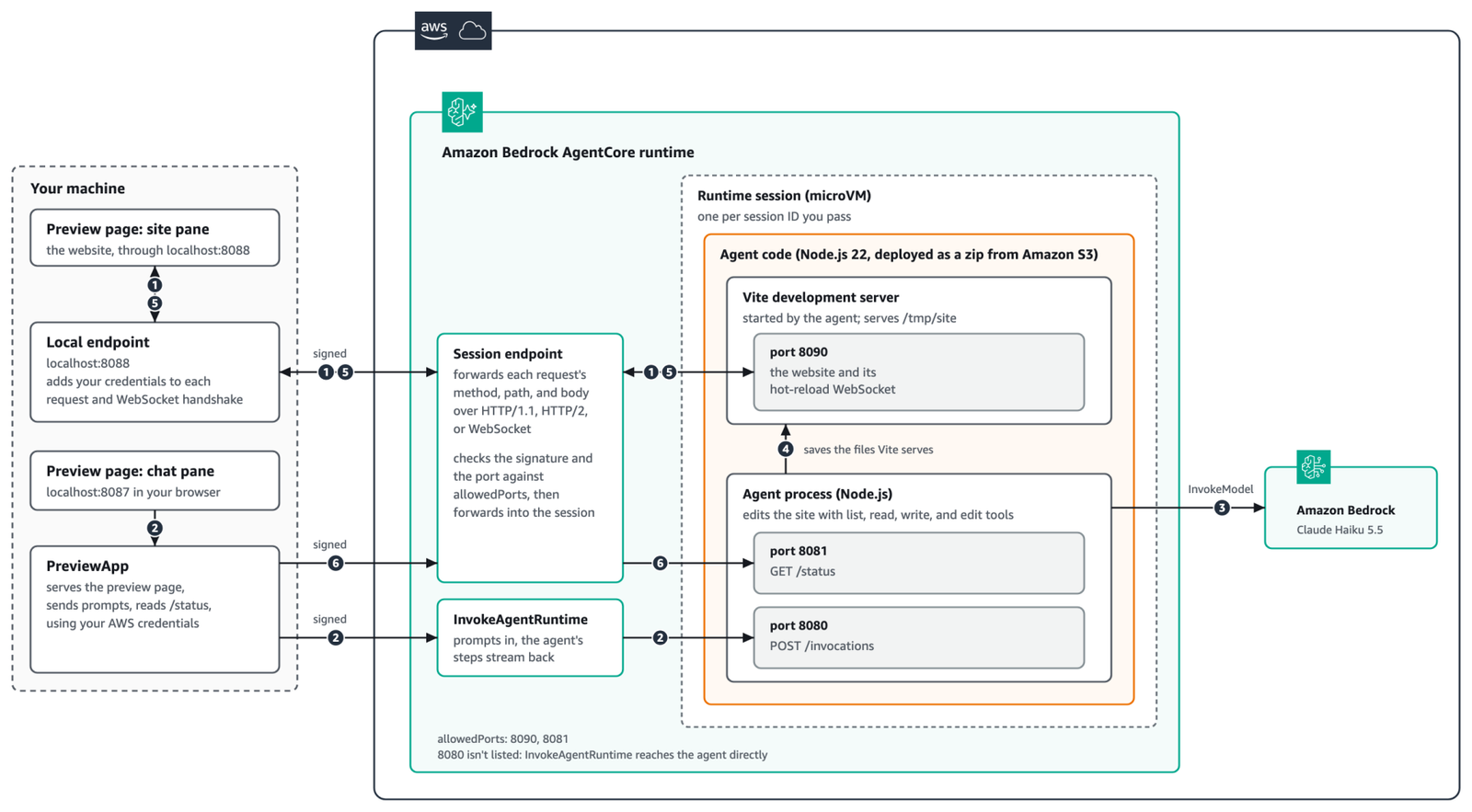
Amazon Bedrock AgentCore, a platform designed to build, connect, and optimize agents at scale, now integrates session endpoints that enable real-time previews of web applications developed by coding agents. According to the official AWS Machine Learning blog, this feature relies on the AgentCore runtime, which executes each agent session in an isolated microVM. Session endpoints generate authenticated URLs, transmitting HTTP methods, paths, query strings, and WebSocket connections to authorized ports, all within a secure environment.
This feature allows you to request a change, see the result instantly, and then adjust again without waiting for a traditional compilation cycle to complete.
An accelerated development workflow thanks to live preview
The major innovation lies in the ability to preview a web application under construction through an integrated chat interface, named PreviewApp. The coding agent, using tools like list, read, write, or edit, modifies the site files in real time. These changes are immediately visible in the browser thanks to a hot-reload system via WebSocket on port 8090, as explained in the AWS blog. For example, a developer can request a CSS modification, see the result instantly, and then adjust again without waiting for a traditional compilation cycle to complete. This approach leverages Vite, a front-end development tool, to push updates directly into the browser.
Security and session isolation: how does it work?
Session endpoints are designed to be scoped to a single session and require credentials for each request, according to AWS specifications. Once the session is over, access automatically stops. To bypass browser limitations, which cannot add SigV4 signatures or access tokens to requests, a local endpoint on port 8088 is used to add this information before forwarding it to the session endpoint. Additionally, authorized ports must be explicitly configured, and the application must listen on 0.0.0.0 to ensure secure communication. This architecture limits risks while maintaining a smooth user experience.
What this changes here: opportunities for businesses and administrations in West Africa
For Béninese or African technological companies developing software solutions, this advancement could significantly reduce development timelines by enabling rapid and visible iterations. For example, a startup from Cotonou working on a SaaS platform could use this feature to test functionalities in real-time with pilot clients, without waiting for a stable version release. Public administrations, such as those in Benin or Nigeria, could also benefit by accelerating the prototyping of internal applications, such as citizen service portals or management tools, while maintaining strict access control via AWS Identity and Access Management (IAM).
However, the adoption of this technology would depend on the maturity of local cloud infrastructures and team training. Companies would need to assess their ability to integrate tools like AWS Amplify Hosting or the bedrock-agentcore SDK, while ensuring the security of sensitive data. For countries where internet connections can sometimes be unstable, latency could also pose a challenge, although supported protocols (HTTP/2, WebSocket) are optimized for high performance.
Sources
- Preview web apps live as your coding agent builds them with Amazon Bedrock AgentCore runtimeAWS Machine Learning Blog, 30 October 2026
Prepared by Lawing Tech's technology watch from the sources cited. Our editorial charter