
Hi, I am loading the site

Lawing Tech

​

Skip to content
Lawing Tech

Technology watch

News

What matters in cybersecurity, cloud and telecoms, CCTV, software, artificial intelligence and public sector IT, with the essential tech news from Benin and the world. Every article is built on public sources, cited at its end.

Loading the news

Back to news

Microsoft Foundry Opens Access to Copilot Harness for Developers and Enterprises: A Multi-Model Revolution

Microsoft has announced the general availability of the Copilot harness via Microsoft Foundry, a multi-model orchestration layer used internally for years. This infrastructure now allows businesses to build autonomous agents capable of handling long and complex tasks, with optimized management of AI models.

by Lawing Tech Newsroom (4 min read)
Microsoft Foundry Opens Access to Copilot Harness for Developers and Enterprises: A Multi-Model Revolution
Video: Microsoft Copilot Studio harnesses (Microsoft Copilot Studio, YouTube)

Proven Infrastructure at Microsoft Scale, Now Accessible

The Microsoft Copilot harness was designed by the GitHub engineering team before being adopted company-wide, according to the official Microsoft blog. This infrastructure already powers tools like Copilot Code, Copilot Studio, GitHub Copilot, the Copilot CLI command line, and the VS Code editor. Its deployment via Microsoft Foundry marks a key milestone: it is now accessible to developers and enterprise clients.

The harness stands out for its ability to orchestrate over 20 cutting-edge AI models (frontier models), while allowing users to integrate their own access keys (bring your own key). It automatically routes tasks to the most suitable model, optimizing performance and efficiency. A key feature for businesses seeking to avoid unnecessary costs from oversized models.

The infrastructure enables businesses to focus on designing agents rather than managing the underlying infrastructure, freeing up resources for innovation.

Microsoft Copilot
Logo: Microsoft Copilot (Microsoft, Public domain)

Autonomous Agents for Complex and Secure Tasks

One of the major strengths of the Copilot harness lies in its ability to manage agents capable of reasoning, using tools, and executing long and complex tasks, as Microsoft explains. Unlike traditional solutions, this infrastructure does not limit itself to one-off interactions: it supports end-to-end workflows, with integrated governance for critical decisions. Businesses can thus automate business processes while maintaining human oversight of sensitive steps.

The harness relies on open standards such as the Model Context Protocol (MCP) and supports plugins to extend its functionalities. It also includes a secure environment (sandbox) and optimization mechanisms managed by Microsoft, reducing the burden on developers. According to Unite.ai, this approach allows teams to focus on designing agents rather than the underlying infrastructure.
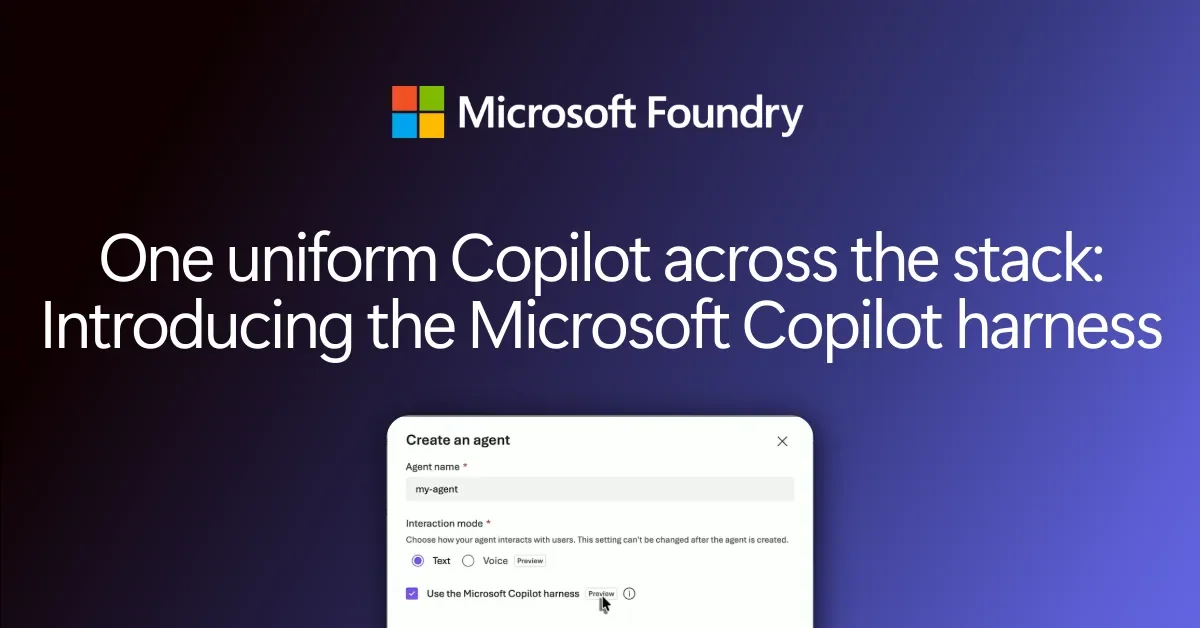
Introducing the Microsoft Copilot harness in Foundry Agent Service | Microsoft Foundry Blog
Image: Introducing the Microsoft Copilot harness in Foundry Agent Service | Microsoft Foundry Blog (Microsoft Foundry Blog, official image)

Performance and cost gains demonstrated by internal projects

Microsoft highlights that the Copilot harness has been tested at scale, with millions of users and hundreds of real use cases. An internal project like HydraFusion, developed by GitHub, illustrates its benefits: by combining three execution schemas (single, cascade, critical), it improved the quality of validated tasks by 4.9 percentage points, while reducing resource consumption by 67% during offline evaluations, according to Unite.ai. These results could inspire African businesses seeking to optimize costs while maintaining high standards.

The harness is also configurable for any type of application, agent, or service. Its runtime, recently ported to Rust, improves performance and reduces latency, an advantage for demanding environments like those in government or financial sectors.

What this changes here: opportunities for businesses and administrations in West Africa

For businesses and administrations in Benin and West Africa, access to the Copilot harness via Microsoft Foundry could open concrete prospects. Local organizations, often facing budget constraints and growing automation needs, could benefit from an infrastructure capable of:

  • Reducing costs by optimizing the use of AI models through intelligent task routing, thus avoiding the extra cost of generic solutions.
  • Automating complex business processes such as supply chain management, administrative request processing, or data analysis, while maintaining human oversight on critical decisions.
  • Securing workflows through a sandboxed environment and integrated governance mechanisms, essential for sensitive sectors like healthcare or finance.
  • Accelerating the development of specialized agents for sectors like agriculture (satellite data analysis), energy (network optimization), or education (personalized learning paths), without requiring expertise in infrastructure.

Administrations could particularly leverage this technology to modernize public services such as tax declarations or property title management, where autonomous agents could pre-process requests before human validation. However, adoption will depend on organizations' ability to integrate this infrastructure into their existing ecosystems, a challenge that will require tailored technical support.

Sources

  1. Introducing the Microsoft Copilot harness: Unlocking the potential of truly multi-model agentic workMicrosoft Official Blog, 28 October 2026
  2. Microsoft Makes Copilot Harness Available Through FoundryUnite.ai, 28 October 2026

Prepared by Lawing Tech's technology watch from the sources cited. Our editorial charter

Latest articles

  1. WordPress 7.1.4: a critical security update fixing major vulnerabilities
  2. Google Cloud enriches VPC Flow Logs with GKE metadata for optimized network monitoring
  3. Prometheus Security Group Global Achieves UL Certifications for Its Zero Trust Physical Security Platform
  4. Lagos Makes Mandatory Health Insurance for Residents Effective from 2027: What Lessons for West Africa?
  5. CISA Launches Its 2030 Strategy for Offensive and Resilient Cybersecurity Amid Rising Threats
  6. Databricks Launches Vital Skills: Specialized AI Skills for Healthcare and Life Sciences
  7. FluidCloud launches vHOP: a key solution for VMware migrations without relying on VDDK
  8. UVS and TIS modernize video surveillance for the West Midlands Metro, tripling network size
  9. The BCEAO Reveals Rising Financial Inclusion in the UEMOA in 2025: Seven Key Indicators to Remember
  10. A former pentester arrested for a massive cyberattack in South Korea using AI ARTEX
  11. Databricks AI Search Extends Native Support for Iceberg Tables, Streaming, and Materialized Views
  12. Microsoft urgently patches critical vulnerabilities in .NET 8 to 11 RC3: risks of memory corruption and privilege escalation
  13. Tata Communications invests 400 to 450 million dollars in a 10,000 km AI-ready fiber network in India
  14. Cyberdione Labs Reveals 11 Unpatched Critical Vulnerabilities in Tailscale SSH and Headscale
  15. BlackX: The UEFI Bootkit Bypassing Secure Boot to Target Kaspersky and Avast in Central Asia
  16. Anthropic releases sandbox-runtime (srt): an open-source tool to secure AI agents without containers
  17. LiteLLM 1.107.0 Compromised: A Python Hook Attack Steals Sensitive Credentials in Professional Environments
  18. Moonshot AI Launches Kimi K3.1 Pro: An Open-Weight Model with 2.8T/104B Parameters and a 1 Million-Token Context
  19. SafePay Ransomware: 600 Organizations Targeted, Authorities Warn of Active Threat
  20. Kazakhstan Deploys 400 NVIDIA GPUs to Accelerate Its AI Ecosystem
  21. pgrecon 0.7.3: an open-source tool for migrating Oracle to PostgreSQL with transparency and clear limitations
  22. PCSC Security and Davista.ai Revolutionize Access Management with Predictive Intelligence
  23. ECOWAS Accelerates Deployment of ECOQMARK and Strengthens Renewable Energy Skills Certification
  24. PHP releases emergency patches for two critical vulnerabilities exploited before official disclosure
  25. Google Research Validates an AI Model to Assess Gestational Age Without Ultrasound Experts
  26. Hanwha Vision Launches the SPS-A8016: An All-in-One Camera to Secure Indoor Spaces with AI and Audio
  27. Digital Africa invests in ChipChip to revolutionize digital agriculture in Ethiopia
  28. PHP releases emergency patches for two undisclosed critical RCE vulnerabilities on October 21, 2026
  29. i14 optimizes its Laplace 3B model on AWS Trainium2 with PyTorch for ultra-efficient linear attention
  30. Amazon ECS Gateway: A Turnkey Solution to Simplify ECS Container Ingress Networking
  31. Gallagher Security Receives NPSA Approval for Its High Sec T30 Biometric Keyboard: A Benchmark in Critical Security
  32. Stanbic Bank Ghana and RD Technologies Test Stablecoins for B2B Cross-Border Payments to Asia
  33. CERT-FR warns of actively exploited critical vulnerabilities: from Windows to Danfoss, systems under scrutiny
  34. TwelveLabs Pegasus 1.5 on Amazon Bedrock: Video Segmentation and Real-Time Processing Now Accessible
  35. The ARCEP of Benin Publishes the Updated List of Approved Radio Equipment and Terminals as of September 30, 2026
  36. ECOWAS and AES: a framework cooperation agreement in preparation after the Dakar ministerial meeting
  37. Drone attack on the chemical tanker Wine Trader: nine Beninese sailors among the missing in the Black Sea
  38. SiteGuard Server Edition: A Critical Flaw (CVE-2026-106931) Exploited to Gain Server Control
  39. The Regulatory Council Rejects Allegations of Irregularities in the GBESSOKE Programme: What Consequences for Public and Private Actors?
  40. Chain Attack via ConnectWise Cloud Backup: How Hackers Exploited Microsoft 365

All the news