Databricks Launches Vital Skills: Specialized AI Skills for Healthcare and Life Sciences
Databricks has released Vital Skills, an open-source set of skills integrated into Genie Code to enhance capabilities in healthcare and life sciences. These tools, developed by experts, ensure more rigorous and compliant analysis, as demonstrated by their performance on BiomniBench and real-world tasks such as cohort detection or model deployment.
by Lawing Tech Newsroom (4 min read)

What is Vital Skills and how does it work with Genie Code?
Vital Skills is an open-source library of specialized skills, developed by Databricks for its coding agent Genie Code. These skills, based on the Agent Skills standard, provide deep expertise in healthcare and life sciences, areas where generic agents often lack rigor. According to Databricks, non-specialized agents, for example, select clinical thresholds without validation or use generic statistical methods instead of tailored tools, as highlighted in the platform’s official blog.
Genie Code, optimized for the Databricks ecosystem, now integrates these skills to guide the application of specific tools and best practices. For example, Vital Skills includes pre-established playbooks covering key steps: data processing, analysis, model lifecycle management, and report generation. These skills are designed to avoid common errors, such as omitting patients in a cohort or failing to verify clinical thresholds, issues observed when using Genie Code alone.
Vital Skills transforms Genie Code into a tool capable of following clinical workflows end-to-end, avoiding silent errors that previously excluded up to half of the patients in a cohort.
Results Measured on Benchmarks and Real-World Cases
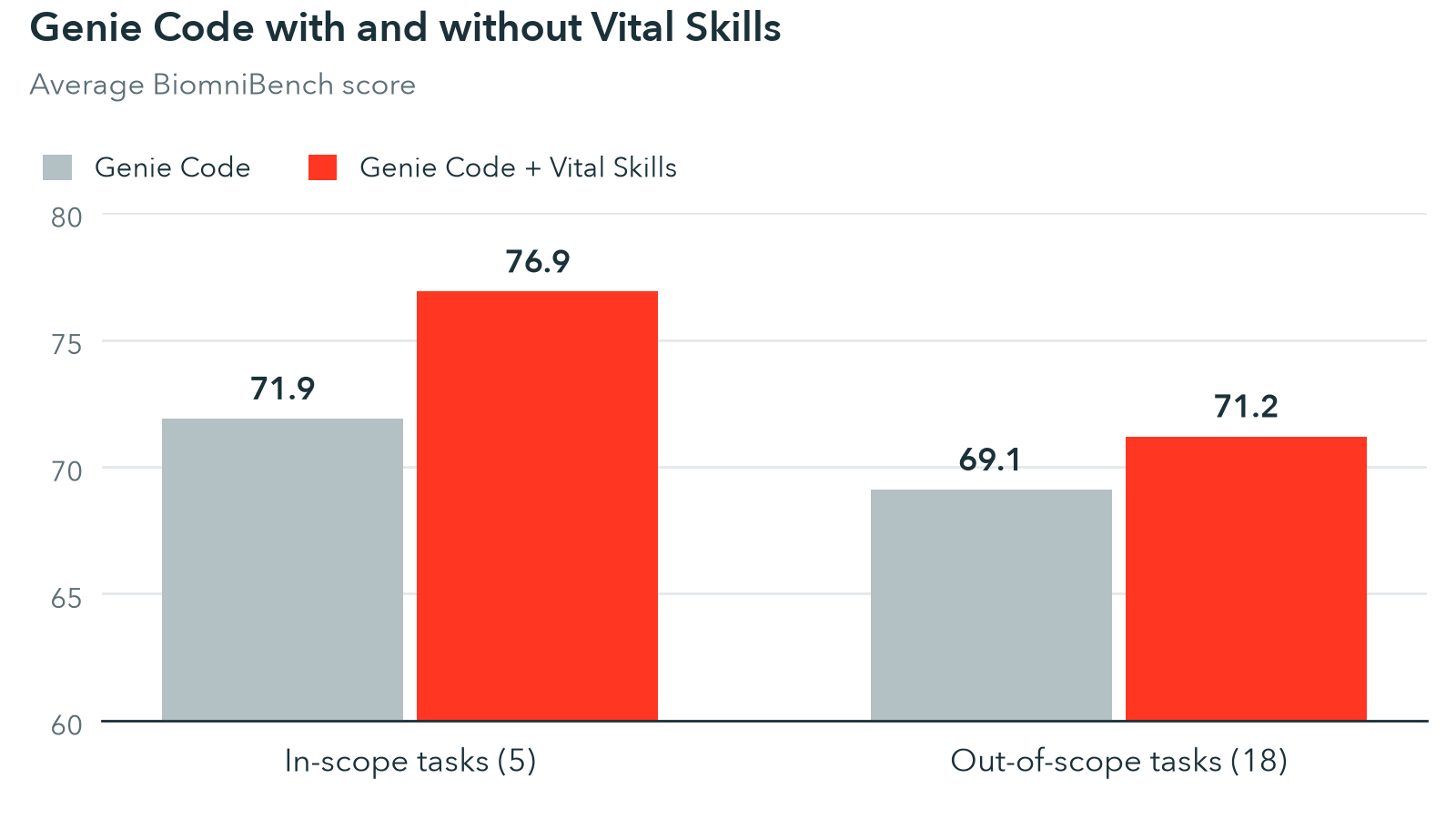
The effectiveness of Vital Skills has been evaluated across multiple criteria. First, on the BiomniBench benchmark, Genie Code equipped with these skills outperformed its non-specialized version, demonstrating better consistency, precision, and rigor while reducing missed steps or backtracking, as indicated by Databricks. For example, during a single-cell model deployment task (TEDDY model), Genie Code without Vital Skills validated only 19 of the 27 pre-deployment checks, compared to 27 out of 27 with the integrated skills.
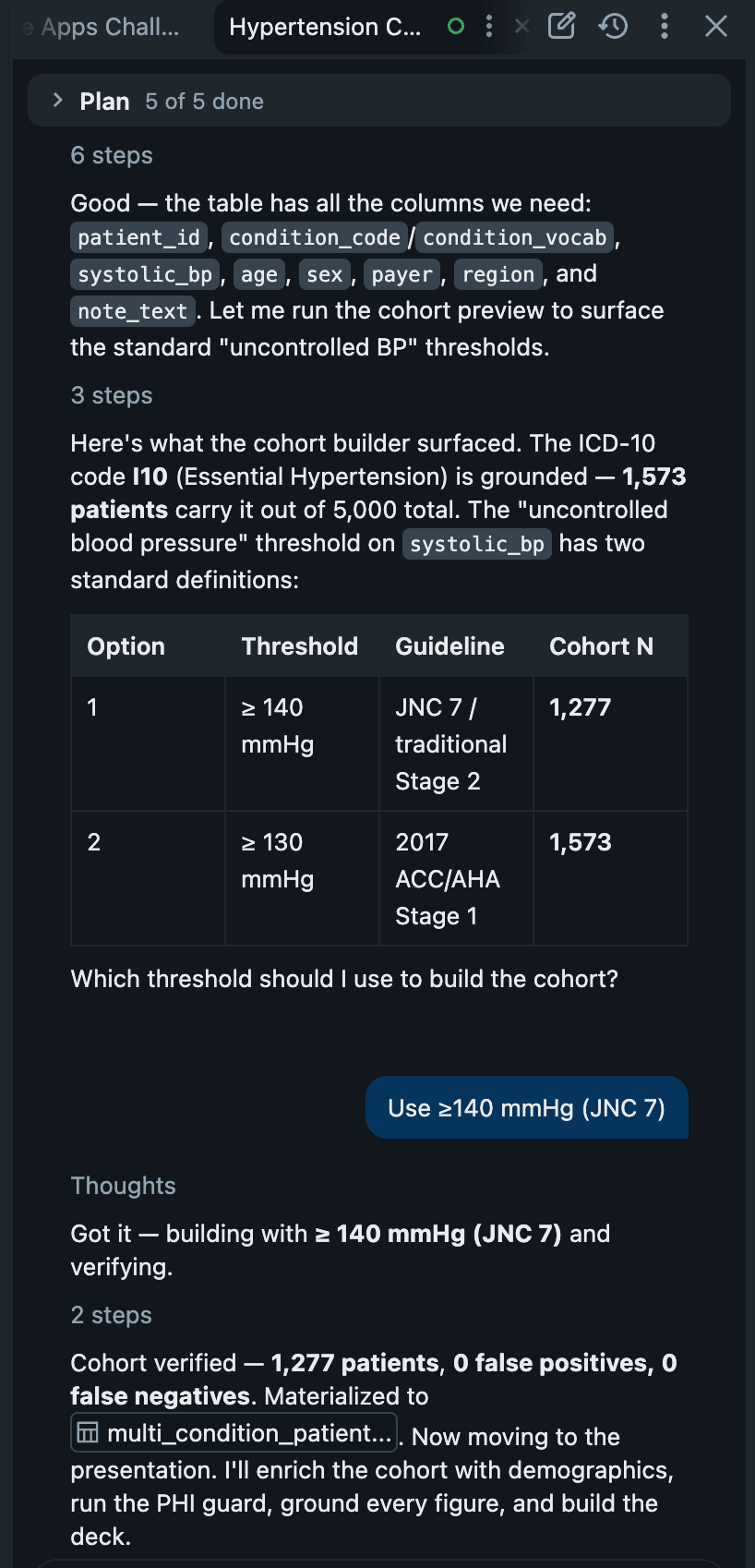
In a real cohort-building case, Genie Code without Vital Skills incorrectly excluded half of the eligible patients, while the enhanced version recovered all cases. These gains stem from strict design principles, such as ‘Ask before assuming’: the agent pauses to present options to the clinician before making a critical decision, or ‘Trust-tested tools’, which prioritizes validated tools over improvised logic, according to principles detailed by Databricks.
Deep integration with the Databricks ecosystem and industry standards
Vital Skills does not merely enhance technical performance: it also integrates with Databricks governance tools. Genie Code, via Unity Catalog, understands the company’s data management rules and complies with compliance constraints, thus avoiding isolated environments where data would not be traceable. This integration is crucial for organizations working with sensitive data, such as those subject to HIPAA (Health Insurance Portability and Accountability Act) or equivalent local regulations.
Vital Skills competencies cover varied workflows: bioinformatics (with tools like bulk-rnaseq for RNA analysis), clinical cohort construction (cohort-builder), data de-identification (phi-deidentifier), or semantic report generation (semantic-builder). These modules enable the transition ‘from raw data to the final product,’ as described by Databricks, relying on natural language descriptions for tasks such as cohort construction.

What this changes here: opportunities for businesses and administrations in West Africa
For healthcare facilities and research laboratories in West Africa, where medical and biomedical data are often scattered and underutilized, Vital Skills could provide a framework to structure clinical data analysis. For example, hospitals using heterogeneous information systems would benefit from automating tasks such as detecting patient cohorts for epidemiological studies while complying with local data protection standards. De-identification skills (phi-deidentifier) could also facilitate secure data sharing with international partners, a major issue for research on diseases like malaria or HIV.
Public administrations, such as the Ministry of Health of Benin or regional health agencies, could leverage these tools to improve epidemiological surveillance or drug stock management, relying on more rigorous and compliant analyses. However, adoption would depend on the ability to integrate these skills into local infrastructures, often limited in resources. Targeted training for teams and support from partners like Databricks or IT consulting firms would be necessary to fully exploit these advancements.
Finally, local pharmaceutical and biotechnology companies, such as those developing vaccines or diagnostics, could use Vital Skills to accelerate processes like predictive model validation or clinical trial management. The open-source nature of the solution reduces initial costs but requires expertise to adapt the playbooks to specific contexts, for example by integrating data from local systems or customizing clinical thresholds to African realities.
Sources
- Vital Skills: Upskilling Genie Code with Healthcare and Life Sciences skillsDatabricks Blog, 27 October 2026
- Vital Skills: Upskilling Genie Code with Healthcare and Life Sciences skillsdaily.dev, 27 October 2026
Prepared by Lawing Tech's technology watch from the sources cited. Our editorial charter