
Hi, I am loading the site

Lawing Tech

​

Skip to content
Lawing Tech

Technology watch

News

What matters in cybersecurity, cloud and telecoms, CCTV, software, artificial intelligence and public sector IT, with the essential tech news from Benin and the world. Every article is built on public sources, cited at its end.

Loading the news

Back to news

Databricks launches real-time mode for its Spark pipelines: a revolution for data processing in milliseconds

Databricks has taken a major step by making its Real-Time Mode (RTM) for Spark Declarative Pipelines (SDP) generally available, enabling end-to-end processing latencies in the millisecond range. This innovation eliminates the need for specialized tools like Apache Flink for critical operational pipelines, while integrating advanced features such as fault recovery and dependency management.

by Lawing Tech Newsroom (3 min read)
Databricks launches real-time mode for its Spark pipelines: a revolution for data processing in milliseconds
Video: Real-Time Mode Technical Deep Dive: How We Built Sub-300 Millisecond Streaming Into Apache Spark™ (Databricks, YouTube)

Unified data processing under Spark: the end of technical silos

Databricks announces the general availability of Real-Time Mode (RTM) for its Spark Declarative Pipelines (SDP), a major evolution that unifies batch processing, ETL, and low-latency streaming within a single framework: Apache Spark. According to Databricks, this integration eliminates the need for specialized engines like Apache Flink for real-time operational use cases. RTM is presented as an evolution of the Spark Structured Streaming engine, now offering comparable, or even superior, performance to dedicated solutions.

The announcement highlights that RTM enables end-to-end latencies on the order of milliseconds for operational streaming workloads. Databricks cites an improvement of up to 92% in speed compared to engines like Flink, while maintaining the advantages of declarative pipelines (SDP), such as automatic dependency management, incremental processing, or fault recovery.

Real-Time Mode eliminates the need for specialized engines like Apache Flink while offering end-to-end latencies in the millisecond range, a first for Spark pipelines.
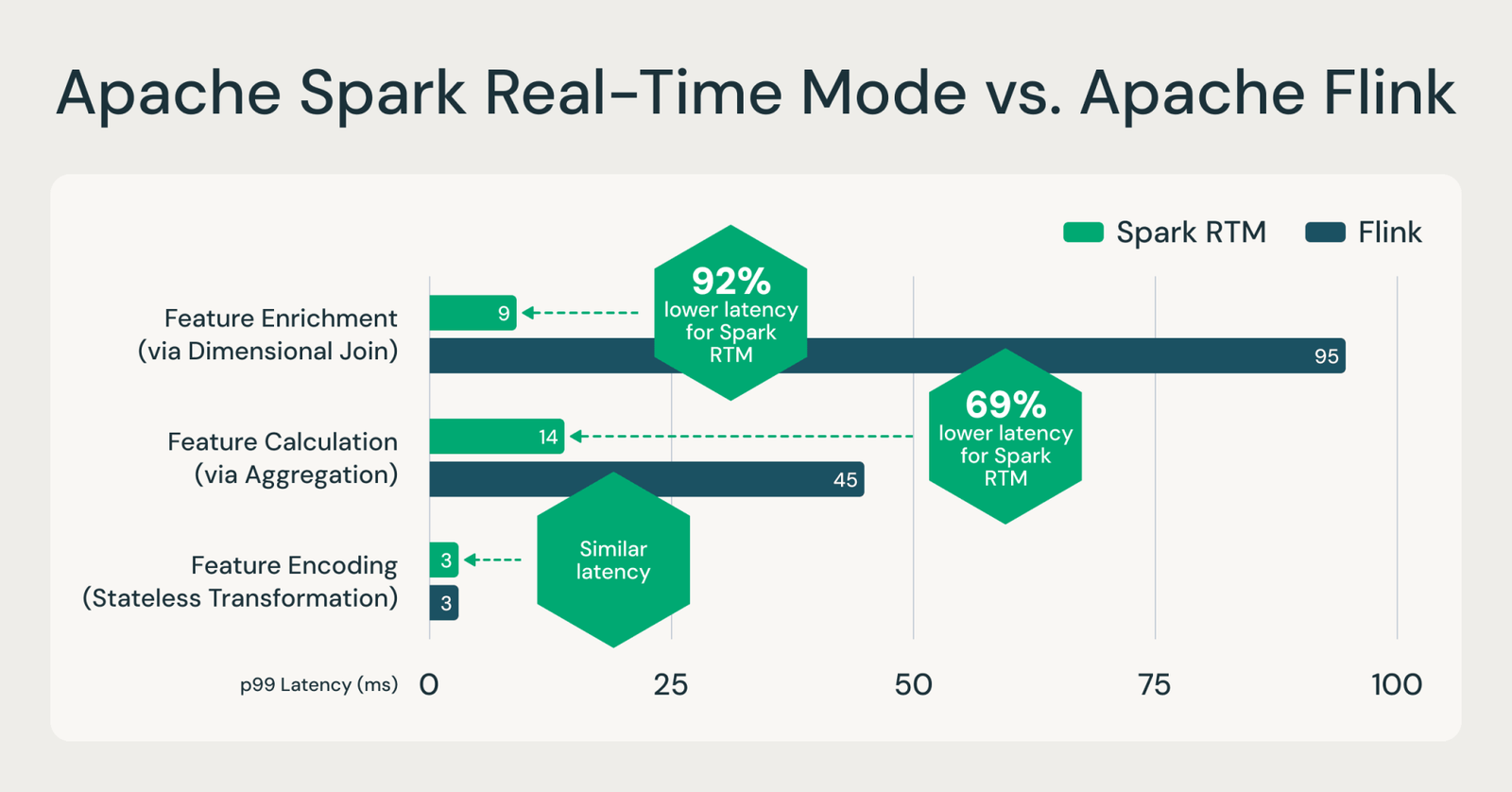
Apache Spark Real-Time Mode vs. Apache Flink
Image: Apache Spark Real-Time Mode vs. Apache Flink (Databricks, official image)

Critical performance for demanding use cases: fraud, alerts, and real-time features

RTM on SDP targets scenarios where responsiveness is crucial. Databricks illustrates its potential with applications such as fraud detection, real-time alerts, or the instant updating of features in operational stores. For example, the Databricks Feature Store uses this architecture to achieve a p99 latency of 200 milliseconds from Kafka to the online feature store, a rare level of performance in critical environments.

Another innovation lies in the ability to write features directly into operational stores like Lakebase or Redis, via ForEach sinks. This enables versionless updates and low-downtime maintenance, assets for systems requiring constant availability.

What this changes here: opportunities for Beninese and West African companies requiring agility

For businesses and administrations in Benin and West Africa, where cybersecurity challenges, financial transaction management, or critical infrastructure monitoring are multiplying, this advancement could transform how data is processed in real time. For example, financial institutions could strengthen their fraud detection systems by reducing analysis delays to just milliseconds, thereby limiting losses from suspicious transactions.

Telecommunications operators or mobile payment platforms, facing massive transaction volumes, could optimize their processing pipelines without relying on complex technical stacks. Similarly, public administrations, in their pursuit of more responsive public services (such as digital identity management or electrical grid monitoring), could benefit from reduced latency for real-time alerts or updates.

Finally, native integration with tools like Redis or Lakebase could simplify local system architectures, reducing maintenance costs and downtime. However, its adoption will depend on the maturity of cloud infrastructures and the training of technical teams on declarative pipelines and Spark best practices.

An architecture that simplifies without compromising performance

One of RTM’s key strengths lies in its ability to simplify architectures while maintaining high performance. SDP automatically handles complex tasks such as resolving pipeline dependencies, applying data quality rules, or orchestrating workflows. This reduces the workload of technical teams, who no longer need to manually configure tools like Flink for critical latency requirements.

Databricks highlights that RTM was tested by clients last year, enabling them to process streaming data up to 100 times faster than traditional micro-batch architectures. This scalability could be particularly useful for West African companies whose data volumes are exploding with accelerated digitalization (mobile banking, e-commerce, industrial IoT).

Sources

  1. Announcing General Availability of Real-Time Mode for Spark Declarative Pipelines on DatabricksDatabricks, 29 October 2026

Prepared by Lawing Tech's technology watch from the sources cited. Our editorial charter

Latest articles

  1. Totem and Milestone Systems Join Forces for 24/7 Operational Video Surveillance
  2. ECOWAS Launches 12 National Platforms to Strengthen Cross-Border Cooperation in West Africa
  3. Cisco Patches Critical Exploited Flaw
  4. Microsoft Foundry Opens Access to Copilot Harness for Developers and Enterprises: A Multi-Model Revolution
  5. WordPress 7.1.4: a critical security update fixing major vulnerabilities
  6. Google Cloud enriches VPC Flow Logs with GKE metadata for optimized network monitoring
  7. Prometheus Security Group Global Achieves UL Certifications for Its Zero Trust Physical Security Platform
  8. Lagos Makes Mandatory Health Insurance for Residents Effective from 2027: What Lessons for West Africa?
  9. CISA Launches Its 2030 Strategy for Offensive and Resilient Cybersecurity Amid Rising Threats
  10. Databricks Launches Vital Skills: Specialized AI Skills for Healthcare and Life Sciences
  11. FluidCloud launches vHOP: a key solution for VMware migrations without relying on VDDK
  12. UVS and TIS modernize video surveillance for the West Midlands Metro, tripling network size
  13. The BCEAO Reveals Rising Financial Inclusion in the UEMOA in 2025: Seven Key Indicators to Remember
  14. A former pentester arrested for a massive cyberattack in South Korea using AI ARTEX
  15. Databricks AI Search Extends Native Support for Iceberg Tables, Streaming, and Materialized Views
  16. Microsoft urgently patches critical vulnerabilities in .NET 8 to 11 RC3: risks of memory corruption and privilege escalation
  17. Tata Communications invests 400 to 450 million dollars in a 10,000 km AI-ready fiber network in India
  18. Cyberdione Labs Reveals 11 Unpatched Critical Vulnerabilities in Tailscale SSH and Headscale
  19. BlackX: The UEFI Bootkit Bypassing Secure Boot to Target Kaspersky and Avast in Central Asia
  20. Anthropic releases sandbox-runtime (srt): an open-source tool to secure AI agents without containers
  21. LiteLLM 1.107.0 Compromised: A Python Hook Attack Steals Sensitive Credentials in Professional Environments
  22. Moonshot AI Launches Kimi K3.1 Pro: An Open-Weight Model with 2.8T/104B Parameters and a 1 Million-Token Context
  23. SafePay Ransomware: 600 Organizations Targeted, Authorities Warn of Active Threat
  24. Kazakhstan Deploys 400 NVIDIA GPUs to Accelerate Its AI Ecosystem
  25. pgrecon 0.7.3: an open-source tool for migrating Oracle to PostgreSQL with transparency and clear limitations
  26. PCSC Security and Davista.ai Revolutionize Access Management with Predictive Intelligence
  27. ECOWAS Accelerates Deployment of ECOQMARK and Strengthens Renewable Energy Skills Certification
  28. PHP releases emergency patches for two critical vulnerabilities exploited before official disclosure
  29. Google Research Validates an AI Model to Assess Gestational Age Without Ultrasound Experts
  30. Hanwha Vision Launches the SPS-A8016: An All-in-One Camera to Secure Indoor Spaces with AI and Audio
  31. Digital Africa invests in ChipChip to revolutionize digital agriculture in Ethiopia
  32. PHP releases emergency patches for two undisclosed critical RCE vulnerabilities on October 21, 2026
  33. i14 optimizes its Laplace 3B model on AWS Trainium2 with PyTorch for ultra-efficient linear attention
  34. Amazon ECS Gateway: A Turnkey Solution to Simplify ECS Container Ingress Networking
  35. Gallagher Security Receives NPSA Approval for Its High Sec T30 Biometric Keyboard: A Benchmark in Critical Security
  36. Stanbic Bank Ghana and RD Technologies Test Stablecoins for B2B Cross-Border Payments to Asia
  37. CERT-FR warns of actively exploited critical vulnerabilities: from Windows to Danfoss, systems under scrutiny
  38. TwelveLabs Pegasus 1.5 on Amazon Bedrock: Video Segmentation and Real-Time Processing Now Accessible
  39. The ARCEP of Benin Publishes the Updated List of Approved Radio Equipment and Terminals as of September 30, 2026
  40. ECOWAS and AES: a framework cooperation agreement in preparation after the Dakar ministerial meeting

All the news